To help you navigate our blog more easily - this link - https://wherenexthun.blogspot.com/2025/06/how-to-navigate-our-blog.html will take you to a summary page detailing all our blog posts. Clicking on a link will open that post in a new browser window. To return to the home current page just close the browser page and return to the post you were reading beforehand.
Nothing to do with motorhomes this post; all about astrophotography. Followers of this blog will know that periodically I post about my astronomy antics whilst at motorhome sites.
Today, some very welcome end of year ingenuity. Wish I'd had this through the year but better late than never I guess.
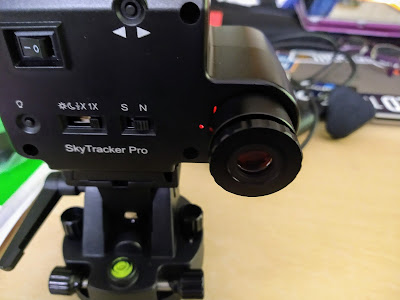
I use an Ioptron Skywatcher Pro star tracker. It is the smallest of the star trackers and a clever little gizmo. It allows me to take far longer exposure photos at lower ISO of the night skies above me. It is also great for astrophotography landscape pictures under the Milky Way. It goes with me in the motorhome every time we travel in it.
My Ioptron Skytracker Pro with the polarscope in its slot on the right hand side
Two niggles I have with it are
- its low payload - 2lbs 8ozs without additional counterweights - so I can just about use my DSLR with its 250mm lens on before I get star trailing
- the polarscope arrangement - which has you on bended knees with a cricked back.
There isn't an astrophotographer alive who uses a star tracker who doesn't understand this last issue. here at a latitude of 50N - the tilt of the tracker is such that when the polarscope is inserted, you are on your knees with your back arched to look up through it. If you can do that! When I'm on my knees below it, my eye is around 14" away from the viewfinder - rendering it useless!
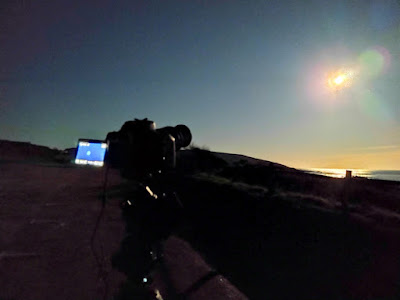
Down at the beach using the skytracker for the first time
It is actually midnight with a full moon - a useless time to try and use a star tracker as all the milky way is washed out from moonshine. You live and learn! 😂
(I should at this point explain that a polarscope is essential to getting good alignment with the stars so that the camera tracks their movement above. This involves aligning the tracker with the north star Polaris. The bigger the lens you use, the more accurate you have to be in your alignment processes - otherwise you will have horrible trailing stars and photos that cannot be stacked together in any available software.)
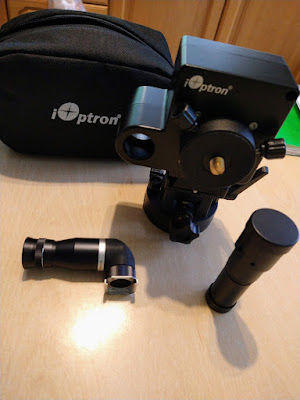
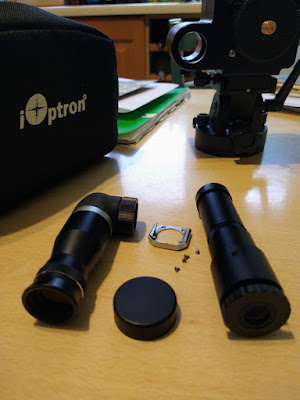
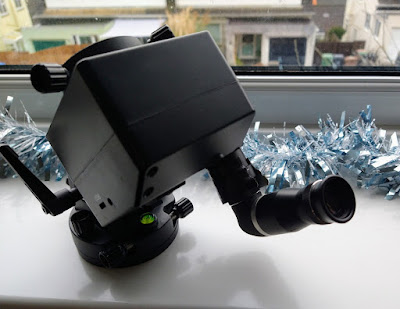
Take one polarscope, one sky tracker and one right angle DSLR viewfinder.....
Anyway, cut a long story short. I was mulling over this conundrum a few days ago when sudden inspiration hit me - a solution to the issue. Now, to be fair, I probably saw a similar idea sometime during the year on a forum or in a magazine and ignored it because at the time it didn't seem relevant to me. However, my brain must have filed the germ of an idea away somewhere and this is what surfaced today.
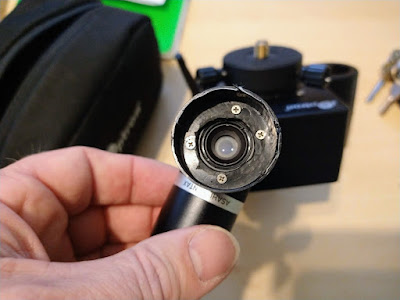
I managed to purchase off ebay a very old but functional right angle DSLR viewfinder for £20. Now a purpose designed right angle viewer for a polarscope retails at £69 plus!
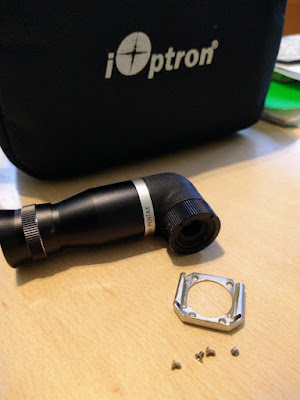
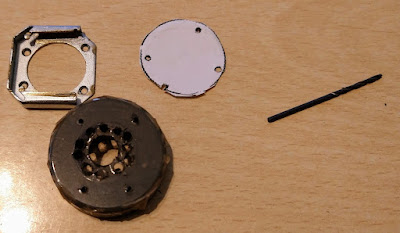
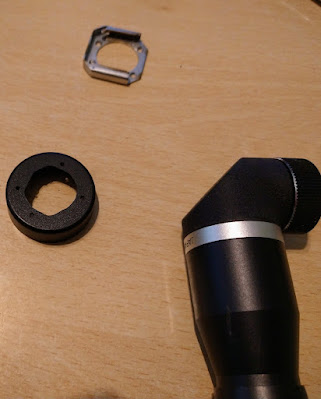
I removed the metal silver viewfinder frame off my ebay purchase by undoing the four tiny screws and then took the protective cover lid off the polarscope. Using the silver viewfinder slot as a template I then marked out drill holes and also a central large hole to be cut out.
Ten minutes judicious use of my multi-tool with drill and then sander bits and hey presto - the protective lid had been cut out. It was then just a matter of screwing the lid back onto the DSLR viewfinder and then doing a few trial fits.
It proved to be a little loose but a thin strip of duct tape on half of the lid lip - turned it to a fairly snug push-on fit.
Does it work? OF COURSE IT DOES! 😁
I have genuinely surprised myself - no more wet knees, cricked neck or wrecked back muscles.
Now if only the clouds would clear for a few hours around midnight!! 😭
And a few shots I have managed to take in the first six months of learning a new hobby.......enjoy
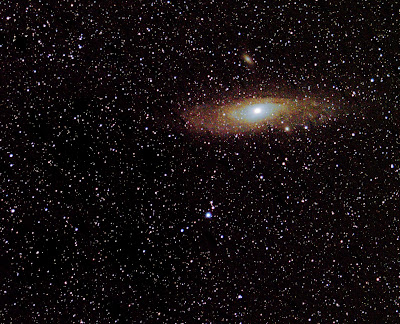
A very first effort at M31 Andromeda galaxy
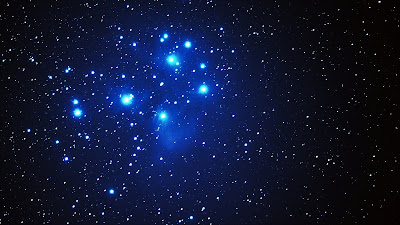
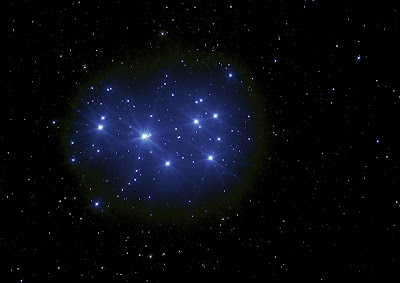
Second effort at M45 Pleaides
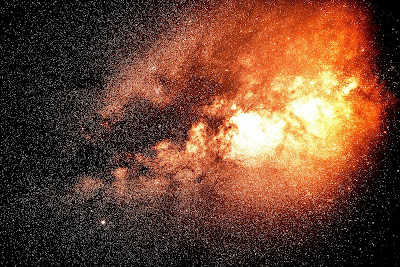
First effort at the milky way - this is cropped in on the image - the galactic core
First effort at M45
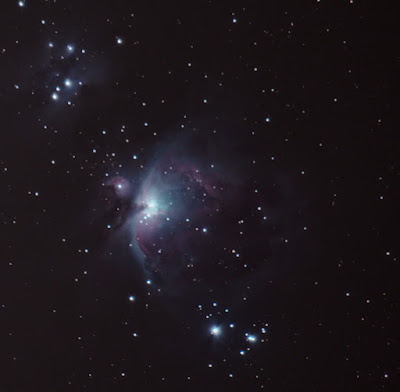
First effort at the Orion nebula
Comments
Post a Comment
Hi, we always look forward to hearing your comments, tips and thoughts. Drop us a line or two below. Take care now. Steve and Maggie